


Bhumika Trust v. Union of India & Ors.
Supreme Court of India | Judgment dated 21 August 2026
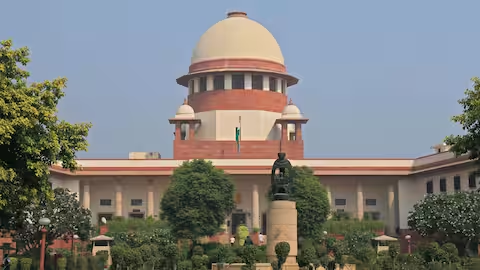
In a significant development concerning recruitment to the subordinate judiciary, the Supreme Court of India has modified its earlier decision imposing a three-year practice requirement for candidates seeking direct recruitment as Civil Judge (Junior Division).
The Court has reduced the mandatory pre-examination practice requirement from three years to one year. At the same time, it has introduced a structured system of one year of judicial academy training followed by one year of supervised law clerkship for candidates selected to the judicial service.
The judgment was delivered by a Bench comprising Chief Justice of India Surya Kant, Justice Augustine George Masih and Justice K. Vinod Chandran, with Justice K. Vinod Chandran dissenting from the majority decision.
Three-Year Practice Rule Modified
The Supreme Court’s earlier judgment of May 2025 had restored the requirement that candidates seeking entry-level judicial service must possess three years of legal practice before appearing for the Civil Judge (Junior Division) examination.

The review proceedings challenged the requirement, particularly in light of its impact on young law graduates who had planned their careers under the earlier recruitment framework. The present judgment does not completely dispense with the requirement of practical legal exposure. Instead, the majority has modified the earlier rule by reducing the mandatory period of prior practice to one year. For recruitment notifications issued on or after 1 April 2027, candidates will therefore be required to possess at least one year of actual legal practice before appearing for the examination.
One Year of Practice + Two Years of Structured Training
The revised framework is significant because the Court has simultaneously strengthened the post-selection training process.
Candidates selected for judicial service will undergo:
– One year of intensive training at the State Judicial Academy
followed by
– One year of structured law clerkship under Judges.
Thus, the new model combines one year of pre-examination practice with two years of post-selection practical training.
The objective is to ensure that candidates entering the judiciary possess not only academic knowledge and competitive examination skills but also meaningful exposure to courtroom functioning and judicial work.
Transitional Relief Till 31 March 2027
A significant aspect of the judgment concerns candidates affected by the earlier three-year requirement.
For recruitment notifications issued between 20 May 2025 and 31 March 2027, the Supreme Court has waived the prior practice requirement.
Accordingly, law graduates covered by this transitional period can participate in the Civil Judge (Junior Division) recruitment process without completing the earlier three-year practice requirement. However, candidates selected under this transitional arrangement will not immediately enter regular judicial service. They will initially be appointed as Trainee Judicial Officers and will be required to undergo the prescribed training and clerkship programme.
They will undergo:
- One year of judicial academy training; and
- One year of structured clerkship under judicial supervision.
The transitional arrangement therefore provides relief to candidates caught between the previous and revised eligibility regimes while retaining substantial practical training after selection.
Genuine Legal Practice Remains Important
The reduction from three years to one year should not be interpreted as the Supreme Court treating practical legal experience as unnecessary. The Court has retained the principle that a prospective judicial officer should have meaningful exposure to the functioning of courts, legal proceedings and the practical realities of litigation.
The revised approach instead recognizes that the mere passage of three years at the Bar does not necessarily guarantee meaningful courtroom experience. Consequently, the Court has sought to combine limited prior practice with structured judicial education and supervised professional exposure.

Structured Clerkship
The one-year clerkship constitutes a particularly important feature of the revised framework.
Selected candidates will receive supervised exposure to judicial functioning through clerkship under Judges. The arrangement is intended to bridge the gap between legal education and the responsibilities of judicial office.
The clerkship is therefore not merely an additional eligibility condition but forms part of the Court’s broader attempt to create a structured pathway from legal education to judicial responsibility.
Justice K. Vinod Chandran’s Dissent
Justice K. Vinod Chandran dissented from the majority’s decision to relax the three-year practice requirement.
In his dissent, Justice Chandran maintained that there was no sufficient basis to interfere with the earlier decision restoring the three-year practice requirement. He emphasized the importance of courtroom experience in developing the qualities required of a judicial officer.
The dissent notably stresses the courtroom’s role as a formative environment for future judges and raises concerns that reducing the period of Bar practice could affect the development of judicial temperament and practical competence.
The majority and dissent therefore reflect two competing approaches: structured institutional training versus longer pre-selection experience at the Bar.
Significance for Law Students and Judicial Aspirants
The judgment will have a direct impact on thousands of law graduates aspiring to enter the lower judiciary.
Under the regime applicable to recruitment notifications from 1 April 2027, the broad pathway will be:
LL.B. Degree
↓
One Year of Actual Legal Practice
↓
Judicial Service Examination
↓
One Year State Judicial Academy Training
↓
One Year Structured Clerkship
↓
Completion of Training and Assessment
↓
Appointment to Judicial Service
The judgment therefore makes judicial service more accessible to young law graduates while simultaneously ensuring that successful candidates receive substantial practical training before assuming regular judicial responsibilities.
Balancing Accessibility and Judicial Competence
The Supreme Court’s approach seeks to balance two important considerations. On one hand, the three-year practice requirement could delay entry into judicial service and create an additional barrier for young graduates who intend to pursue a judicial career immediately after completing their legal education. On the other hand, judicial officers exercise significant powers affecting liberty, property and legal rights. Practical familiarity with courts and litigation is therefore essential. The revised framework attempts to reconcile these concerns by reducing the pre-examination requirement while significantly strengthening post-selection judicial training and clerkship. In effect, the Court has shifted part of the emphasis from years spent practising before the examination to structured practical formation after selection.

Wider Implications
The judgment may also have broader implications for the relationship between legal education and judicial recruitment.
Law schools primarily provide academic and doctrinal foundations, while legal practice provides exposure to advocacy and courtroom realities. Judicial academies, meanwhile, are responsible for preparing selected candidates for adjudicatory responsibilities.
The new framework attempts to connect all three stages:
Legal Education → Legal Practice → Judicial Training → Judicial Service
The success of this model will therefore depend significantly upon the quality of training provided by State Judicial Academies and the effectiveness of the structured clerkship programme.
Conclusion
The Supreme Court’s judgment in Bhumika Trust v. Union of India & Ors., pronounced on 21 August 2026, marks a significant change in the recruitment pathway for Civil Judges (Junior Division). The Court has reduced the mandatory prior practice requirement from three years to one year for recruitment notifications issued on or after 1 April 2027, while introducing one year of judicial academy training and one year of structured clerkship for selected candidates. For recruitment notifications issued between 20 May 2025 and 31 March 2027, the Court has provided transitional relief by waiving the prior practice requirement, while requiring selected candidates to undergo the prescribed trainee judicial officer framework.
The decision consequently represents more than a reduction in the number of years required at the Bar. It reflects a broader judicial policy shift towards combining professional exposure with structured institutional training.
The ultimate success of the revised system will depend upon whether the training and clerkship programmes provide genuine, rigorous and meaningful exposure to judicial work.
For aspiring judicial officers, the message is clear: clearing the judicial service examination may open the door to the judiciary, but practical training and supervised judicial experience will remain integral to becoming a competent judicial officer.


